Principles: Distortion

CLO11: Summarize the relationship of factors that control and affect distortion.

Image result for distortion xray"

Distortion is controlled by the factors of source-image receptor-distance, object-image receptor-distance and kVp. Source-image receptor-distance is the distance from the target of the x-ray tube to the image receptor. SID affects things like magnification of the body part. For example, if the SID is decreased then the magnification is also decreased. Object-image receptor-distance is the distance between the anatomy to the image receptor. OID affects the radiation intensity as well as the magnification. For example, if the OID is increased then the magnification is also increased. Kilovoltage peak decides the penetrability of the beam meaning if the kVp is too low then the anatomy is not being accurately penetrated.

Principles: Size and Shape Distortion

CLO09: Differentiate between size and shape distortion.

Size distortion is the increase in size of the image’s anatomical part compared to the part’s actual size and must occur over the entire image. SID and OID are factors that affect magnification and especially size distortion. Sometimes size distortion will always occur because of OID. SID can affect magnification because as it increases, size distortion decreases. There is an inverse relationship. Shape distortion is the misrepresentation of the image’s shape. The image can then be elongated or foreshortened. A few errors that can cause shape distortion is the misalignment of the central ray of the x-ray tube, anatomical part or image receptor.

Principles: Radiographic Contrast

CLO06: Analyze the relationship of factors that control and affect radiographic contrast.

Radiographic contrast is controlled by kilovoltage peak. A high kVp indicates less absorption, more transmission and a low contrast while a low kVp indicates more absorption, less transmission and a high contrast. Low contrast means there are going to be more shades of grey displayed. High contrast means there are going to be less shades of grey displayed.

Principles: Image Exposure

CLO04: Analyze the relationships of factors that control and affect image exposure.

Image result for image exposure xray"

Image exposure is controlled by kilovoltage peak (kVp) and milliampere-seconds (mAs). Kilovoltage can alter the penetrating ability of the x-ray beam as well as the amount of penetrability. Milliampere-seconds is directly proportional to the exposure. The anatomy must first be penetrated before mAs can be adjusted. If the kVp is too low then the beam will not penetrate the part and will become scatter radiation. The 15 percent rule can be applied to increase exposure to the image receptor. An amount of 0.15 would be multiplied by the original kVp and then add that total to the original kVp.

Principles: Radiographic Exposure

CLO03: Assess radiographic exposure on radiographic images.

Image result for xray of a femur"
Lgm 1.50

The imaged proximal femur above will be assessed for its radiographic exposure. This image has a exposure number of 1.50 LgM. Based on the chart below, the optimal range for the digital equipment Agfa is 1.6-2.2 LgM. Comparing the numbers, it is shown that 1.50 LgM is lower than the range indicated meaning the image is underexposed. Correct technique needs to be demonstrated.

Image result for exposure indicator  in cr chart"

Physics: Particulate Radiation

CLO16: Describe particulate radiation.

Particulate radiation is a type of ionizing radiation that uses subatomic particles that are in motion and have adequate kinetic energy. There are two main subatomic particles named alpha particles and beta particles. An alpha particle is a large helium nucleus that contains a positive electric charge and only emit from heavy elements. These particles cannot penetrate most items. A beta particle is an small electron that originates from a unstable nucleus and carries a negative as well as a positive charge. Beta particles can are emitted from radioisotopes and can penetrate light items.

*

Physics: Properties of X-Ray

CLO15: Identify the properties of x-ray.

X-rays have properties that are unique only to this imaging modality. Some of those properties include x-rays:

  • being invisible
  • being electronically neutral
  • traveling at the speed of light
  • being absorbed or scattered by the tissues in the human body
  • produce secondary radiation
  • causes chemical and biological damage to living tissue
  • being produced in a range of energies

Physics: Energy, Wavelength & Frequency

CLO13: Explain the relationship of energy, wavelength and frequency.

There is a consistent relationship between energy, frequency and wavelength. Frequency and wavelength are indirectly related meaning to increase the frequency allows for the wavelength to be decreased. Frequency and energy are directly related meaning as the frequency is decreased so will the energy. Wavelength and energy are indirectly related meaning as the wavelength is increased the energy will decrease. This is the ongoing relationship between energy, frequency and wavelength.

Physics: Electromagnetic Spectrum

CLO11: Describe the electromagnetic spectrum.

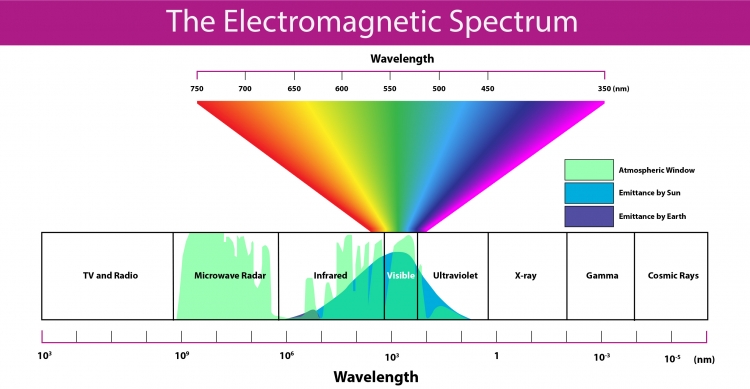
The Electromagnetic Spectrum. Sun emits infrared, visible, and ultraviolet.  The earth emits infrared.

The entire range of electromagnetic energy grouped together is the electromagnetic spectrum. The basic concept of there being a electric and magnetic field that travels at the speed of light is the same. The only difference is the frequency and wavelength of the various photons. Frequency and wavelength are inversely proportional of each other because the velocity stays constant. The orders of the electromagnetic spectrum goes as follows radio-frequency, microwaves, infrared waves, visible light, ultraviolent light to x-ray and gamma rays.

The electromagnetic spectrum equation states E (energy)=h (plank’s constant)*f (frequency of the photon).

Design a site like this with WordPress.com
Get started